Frequently Asked Question
Commonly
asked questions on installation and maintenance of turf
How much soil is required?
4-6 inches would be good - turf will live on less soil but would require
more fertilizer and watering to maintain it on a smaller soil base. Soil
should be a dark loamy type as apposed to gravel or sub-soil.
How do I prepare the soil?
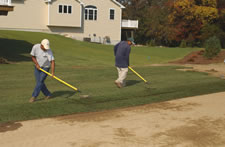
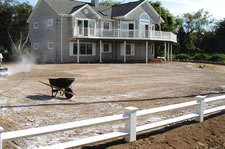
On existing soil, rototill at least 6 inches in depth; rake out all rocks
and debris so as to get the soil as clear of obstruction as possible. Add
lime to the soil. A starter fertilizer can be used but only if it is raked
in or tilled into the soil. Spreading fertilizer on the soil surface then
laying turf on it could cause the root of the turf to be burned by the
nitrogen in the fertilizer. A final rolling of the surface will help to
get the surface smooth. Turf follows the contour of the prepared ground
- if the ground is bumpy the turf will look that way. Rolling should firm
up the surface so as not to allow foot prints and depressions but should
not create a final surface that is hard as a rock.
How
do I lay the turf?
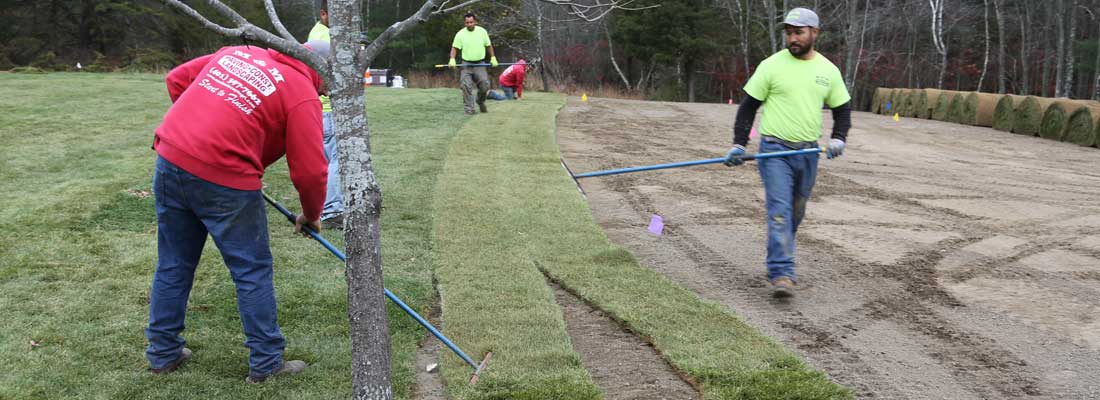
Lay the turf in rows that are staggered - creating a brick wall effect.
Staggering encourages the seams to fill in quicker. Pieces should abut
each other but not overlap or leave an opening between the pieces. A final
rolling ensures that the roots will make uniform contact with the ground
and squeeze out all air pockets.
How should I water the turf?
Newly installed turf needs an inch of water every day in warm weather conditions.
The best way to determine an inch of water (because water pressure differs
from place to place) is to put a can under the sprinkler - when there is
an inch in the can there is an inch in the turf. If we are receiving natural
rainfall then an inch of water every day would have to be adjusted accordingly.
After the turf is established, rooting into the soils will occur with 1
-2 weeks - warm weather watering can be reduced to an inch every other
day.
When should I fertilize my turf?
Wait at least 5 weeks from installation to fertilize the turf. After the
lawn is established, a regular routine of fertilizing 4 times a year should
be implemented.
When do I water?
Begin watering turf within 30 minutes of installation. Make sure your new
lawn receives 1" of water daily while it roots (usually 2 - 3 weeks).
After your lawn is established, heavier, less frequent waterings will encourage
deeper rooting.
Is
it possible to over water turf?
Yes it is possible. Sprinkler systems have made it much easier to over
water. Signs of over watering include flattened slimy looking turf, brownness,
mildew on the blades. A good watering right down to the roots followed
by a period of time where the turf can dry out before the next watering
is the proper way to water. Turf that is saturated with water 24 hours
a day is being set up for mildew and diseases.
Why are there mushrooms in my lawn?
Mushrooms can occur when the conditions are right for them to grow. Hot,
damp and humid weather encourages mushroom growth. A change in weather
where we get dry air and bright sun will cause mushrooms to disappear.
Over watering can also cause the correct conditions for mushrooms to grow.
What about grub treatments?
Grubs are the larval stage of certain insects that will eat turf roots.
The most commonly found grub larva is the Japanese beetle grub. Beetles
fly in and lay eggs from which grubs emerge to eat turf roots. An application
of grub control is recommended in the spring to control grub infestations.
Will turf grow in the shade?
No. Turf requires a minimum of 4 hours of direct sunlight to survive. There
is no turf available that will do well long term in shade. Turf blends
with higher fescue content will do slightly better than a 100% bluegrass
blend. Shade causes turf to thin out over time and become susceptible to
disease.
Can I leave my turf on the pallet for a few days before I lay it?
No. Turf is perishable and needs to be installed as soon as possible in
warm weather conditions. Turf is a living product and therefore generates
heat through composting when rolled up. Rolled up pieces of turf become
hot to the touch and develop a "swampy" smell when rolled up
too long. Classic heating patterns for turf that has been rolled up too
long include yellow circular patterns in the center of each piece to completely
brown individual pieces.
|